
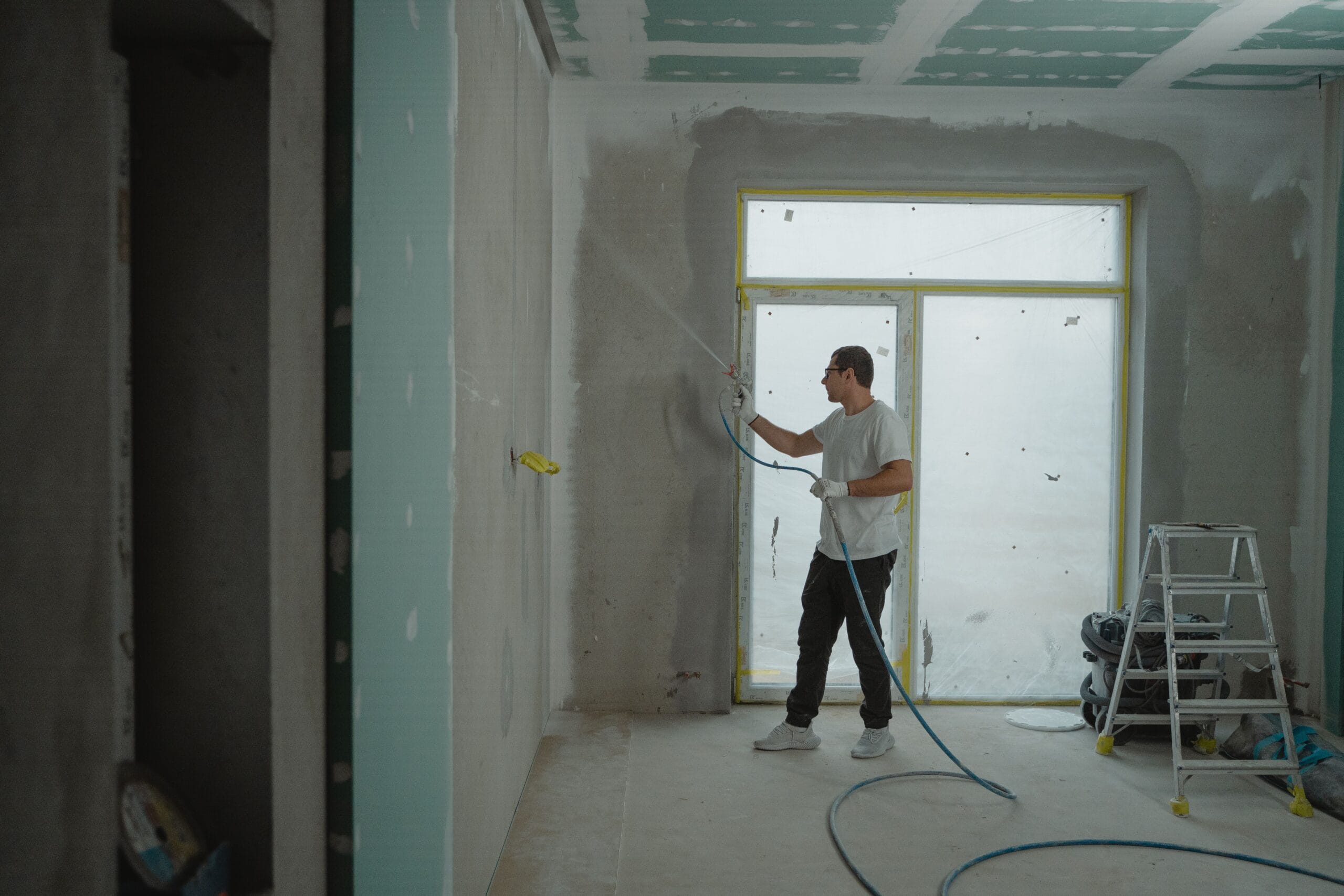
Wondering how long after drywall can you paint? You might feel like you want to get started on painting your new drywall as soon as it looks complete. However, there is another very important step you need to take after you install your new drywall, prior to painting: prepare your wall so that the joint compound is completely dry and your surface is ready for painting.
So, how long after you put up your new drywall will you be able to paint?
For the majority of projects, you should expect to wait at least 24 hours after your last layer of joint compound is applied. This assumes normal indoor temperature and humidity conditions. According to USG, joint compounds typically take approximately 24 hours to dry at a temperature of 70°F and 70% relative humidity. Any higher humidity or temperature combinations could slow down the drying time. While that 24-hour estimate is helpful, use caution. What is far more important than any calendar date is the quality of the wall.
Make Sure the Joint Compound Is Fully Dry
Joint compound is utilized to fill gaps in joints edges, corner areas, fastener head locations on drywall and is typically applied in layers. Each layer must dry prior to application of the next layer.
If the final layer still feels damp or appears darkened in spots or exhibits signs of wetness, applying a finish coat of paint at that point is too early. The finish coat paint will likely not dry or adhere correctly, and previously unnoticed blemishes will now become significantly more apparent once painted.
Temperature and humidity play major roles in terms of drying time. A poorly ventilated, cool, and humid environment will result in slower drying times compared to a well-ventilated, warm area. That is why some professional contractors may require additional time before allowing their customers to proceed with the next steps of preparing their drywall for painting (i.e., prime or paint).
Sand Your Wall Before Painting
After your joint compound dries, your wall is still not ready for painting. Finished drywall must be sanded until it is smooth and free of all imperfections. Joints, screw heads, corners, and areas where the drywall paper meets the joint compound should blend seamlessly together.
Using adequate lighting will help identify if your wall contains any ridges or other uneven surfaces. In many instances, paint does nothing but expose these types of imperfections.
Don’t Skip the Primer
It is recommended that fresh drywall be primed prior to applying the finish paint. New drywall has varying levels of porosity: the paper surface of the drywall absorbs paint differently than areas coated with joint compound. By utilizing a drywall primer, you will assist in achieving a more even absorbency among these areas and produce a better base coat surface for the finish coat. USG explicitly outlines that their drywall primer functions to equalize porosity and reduce visual discrepancies resulting from decoration.
Primers designed specifically for new drywall exist. For example, Sherwin-Williams' PVA drywall primer and sealer was created for bare residential drywall and provides an even surface for the finish coat.
Drying times depend upon the specific products used. Benjamin Moore's drywall primer, for instance, indicates a 30-minute drying time and a 2-hour recoating time under their stated conditions. Always follow the manufacturer's instructions regarding drying/recoating times regardless of what product you choose.
What Is My Total Project Timeline?
Project timelines can vary greatly depending upon several factors including but not limited to:
- the total square footage of the project;
- number of coats needed;
- room temperature and humidity;
- types of materials being used;
Typical sequences include:
1. Drywall installation
Drywall sheets are hung on studs and fasteners are screwed into place.
2. Taping and joint compound
Seams, corners, and fastener heads are taped and finished with joint compound.
3. Drying between coats
Each coat needs sufficient time to dry before subsequent coats are applied.
4. Final drying time
Final coat(s) need ample time to dry before sanding and priming. Again, according to USG, they indicate a general drying time for joint compounds to be around 24 hours based on temperatures and humidity conditions at 70° F / 70% RH.
5. Sanding and inspection
The wall is sanded to remove excess dust or compound and inspected for remaining defects/imperfections.
6. Priming
Primer is applied to seal the surface and achieve greater consistency in paint absorption.
7. Finish paint
Finish paint may be applied once the previous coat or primer has dried per the manufacturer's instructions.
Can You Paint Drywall the Same Day?
Some projects will go fast - but you should never think about painting that fast. There are faster-dry products out there, and professionals have the advantage of using those materials that speed up some parts of the process. However, if it's cooler outside or even a little humid, the compound used for filling joints (seams) will be the slowest part of the whole finishing process.
If you want to know how long after installing drywall you can paint, take a step back and consider the whole “finishing” system as opposed to just looking at the “drying” time. It takes a few things to happen for the wall to be ready for finish paint: it has to be completely dry, smooth, free of debris, and properly primed before you put the finish coat on. Just taking a little bit of extra time during the finishing process will help you get a better end product.
References
USG How Long Does It Take Joint Compounds to Dry?
USG Sheetrock Brand First Coat Primer
Sherwin-Williams PVA Drywall Primer & Sealer
Benjamin Moore Drywall Primer
Benjamin Moore Drywall Primer Technical Data Sheet
0 Comments