
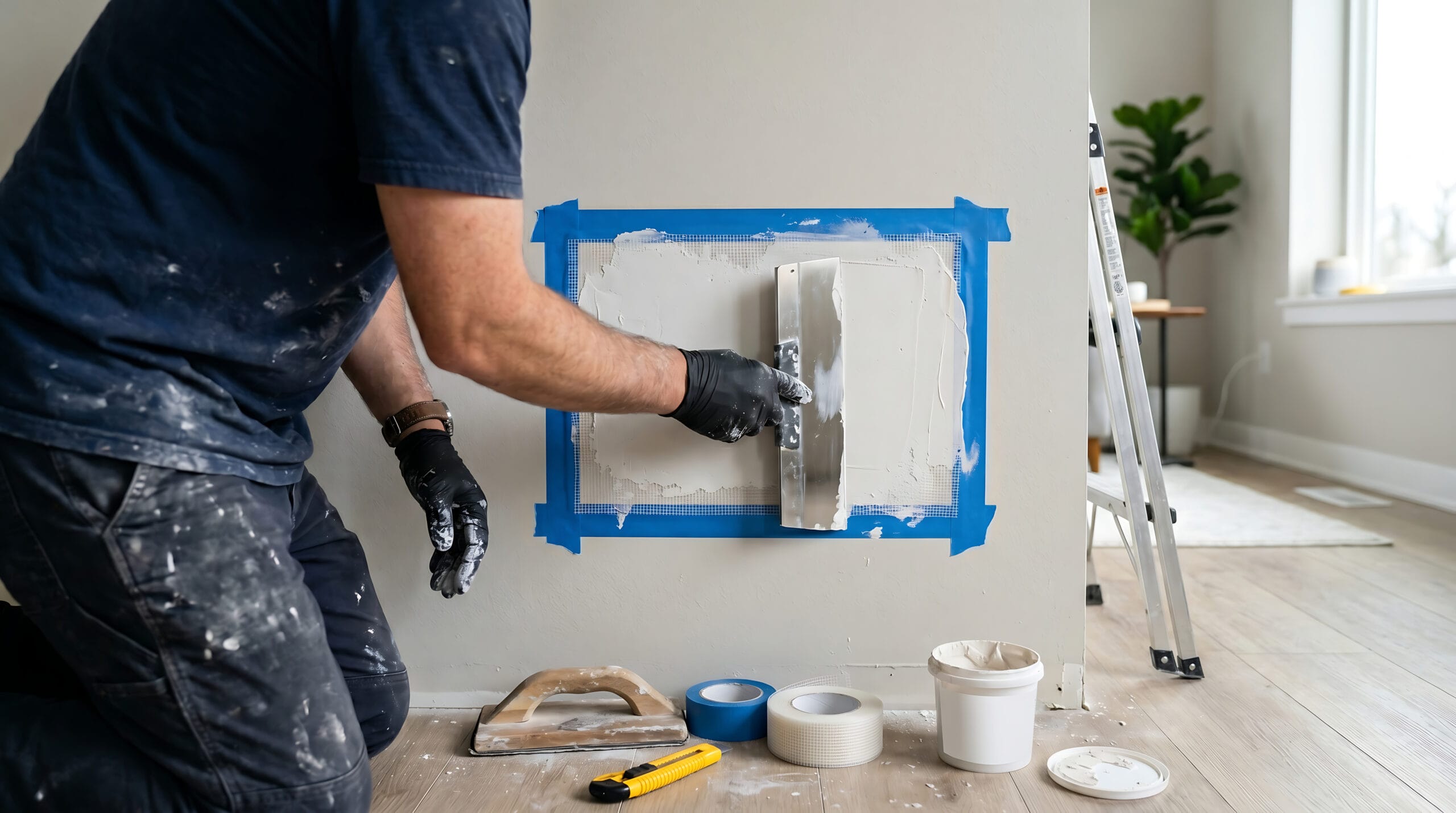
Before you assume the worst - you can often repair drywall instead of replacing it. A hole in the wall doesn't necessarily mean a new sheet of drywall is needed. Some damage can be fixed in an afternoon, while others require a complete replacement. Water damage, large swellings, and widespread problems can necessitate a replacement of part of the drywall, and the difficulty is determining which one is needed. Before deciding between repairing or replacing drywall, size, state of the surrounding walls, and the cause should be examined.
Small Holes: How to Repair Drywall Instead of Replacing It
A few nail holes for hanging pictures, a dent from shifting furniture, or a small hole from a mounted item? There is no need to completely replace an entire sheet of drywall for such damage.
USG offers these instructions for repairing damage like this: clean the area, fill small holes and cracks with joint compound, let the compound harden, sand the repaired area smooth, and prime the surface before painting. The homeowner may need a second layer of compound depending on the damage. (USG) The repairs should be done so that it is not noticeable after the wall is painted.
Larger Holes: You Can Still Repair Drywall Instead of Replacing It
A larger hole presents a larger challenge and may need more work. However, total wall replacement is not a necessity unless the wall is completely covered. Depending on the size and the location, the damaged piece or area can be cut out and replaced with a new piece of drywall. Taping, covering the seams with compound, sanding, and priming allows the repaired area to be painted.
This kind of repair is typical after plumbing or wiring work, accidental damage, or removing an item that was mounted to the wall.
Surrounding drywall matters as well. If the surrounding drywall is soft, crumbling, swollen, or damaged, patching the damaged area may only cover up part of the problem.
Cracks Require Some Further Examination
Not every crack means a complete replacement. Though small cracks can be repaired, the bigger issue is the cause. Shifts in the structure, movement, moisture, or other factors can contribute to cracking. If a crack repeatedly appears after being repaired, simply covering a crack with joint compound will prove to be only a temporary fix.
This is when the homeowner should look into having a professional examine the area before deciding on what repairs are needed.
Water Damage Requires Some Different Consideration
Water presents a unique problem because it is a major cause of drywall replacement. A small amount of water doesn't necessarily require completely replacing drywall. The EPA recommends removing the drywall when there is noticeable swelling of the drywall and the seams are no longer present. In cases where the drywall isn't swollen and the seams hold, drywall can be dried in place after experiencing water damage. (US EPA)
The difference is that painting over a water stain may hide the damage, but it does not replace the damage or solve the leaking problem. Drywall is a porous material, which allows moisture to move into the drywall where it can be challenging to dry out.
What About Mold?
Mold is another situation where a simple patch and paint won't solve the mold problem. The EPA recommends repairing the source of moisture, drying wet materials, and removing any porous materials that can't be sufficiently cleaned. Mold can be difficult to completely remove from porous materials. (US EPA)
The EPA recommends drying wet materials as soon as possible (ideally within 24-48 hours) to prevent mold issues. (US EPA) If the homeowner finds mold or water damage behind their drywall, the proper method is dependent on the amount of damage and the cause.
When Replacement Makes More Sense
There is not a clear rule of thumb about when to patch and repaint vs. when to cut out and replace. Surrounding drywall in combination with the size of the damaged area is important to consider. Replacement is more prudent when drywall is:
- severely swollen or deteriorated
- heavily affected by water or mold
- crumbling or structurally compromised
- damaged over a wide area
- repeatedly cracking or failing after other repairs.
Sometimes simply replacing all or part of a wall can prove more cost-effective than trying to make repairs that can potentially last only a short time. Sometimes the most efficient process is for a professional contractor to cut out the problem areas and replace the drywall so that it can be taped, mudded, sanded, and painted.
The Right Repair Depends on the Cause
The visible issue is only part of the problem. A hole from a doorknob is quite different from a pipe leak hole. A small crack in an otherwise undamaged wall isn't the same as a large crack that keeps reappearing. A water stain is also not the same as drywall that is swollen or moldy.
All of these issues are different, and the appropriate repair or replacement can only be determined after one looks into the cause of the issue.
If you're unsure whether your wall needs a simple patch or a complete section of drywall replaced, you don't have to decide alone.
References
Mold Remediation in Schools and Commercial Buildings Guide: Chapter 4
0 Comments