
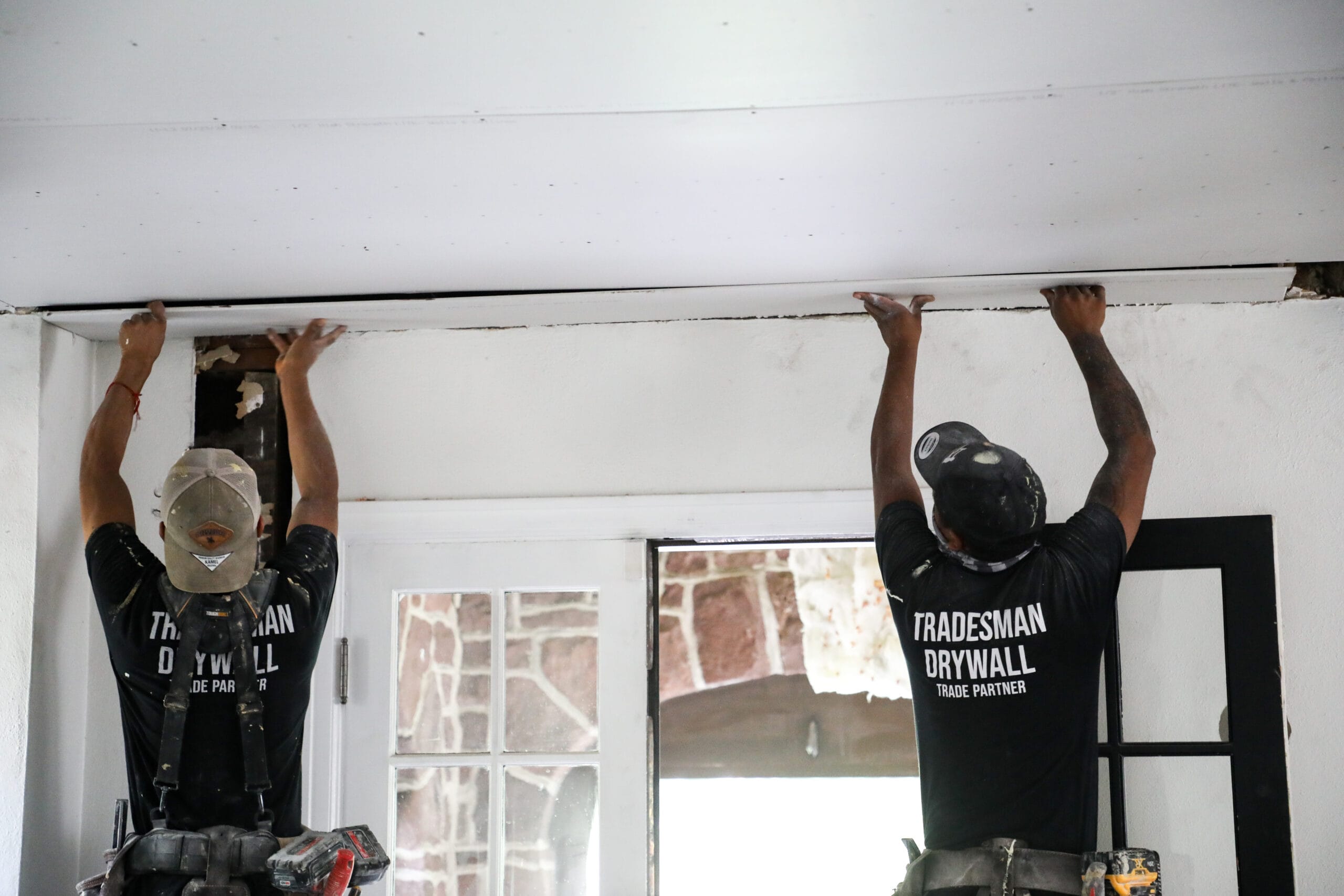
While a small crack, water spot, or damaged piece of ceiling drywall appears as easy to fix as similar damage to a wall, the fact that the ceiling is hanging by gravity affects how contractors will do the job. Ceiling drywall repairs are trickier than wall repairs; the contractor is working overhead, fighting gravity the whole time, which makes it much harder to get a smooth, even finish.
Once you understand what causes this difficulty in fixing a ceiling compared to a wall, it explains why many people think of a "small" ceiling problem requiring professional attention.
Working Against Gravity
When a contractor works at eye level (i.e., working on a wall), they have complete access to the entire area being worked upon. This provides full visibility to see everything the contractor needs to know. When a contractor has to perform work above eye level (i.e., working on a ceiling), there are fewer options available for accessing the area they are going to work on. While the contractor is working overhead, they still need to be able to manage their equipment, tools, etc., in addition to managing the space around them.
Joint compound is more difficult to apply when working overhead due to the effects of gravity pulling down the joint compound. The contractor needs to be able to maintain equal pressure and control every application to avoid excessive build-up on one side of the seam. Additionally, once the joint compound dries, sanding becomes an issue. Sanding large ceiling areas is especially demanding, since the contractor has to maintain even, consistent pressure across the whole surface to avoid visible high or low spots in the finish.
Ceiling Drywall Needs Proper Structural Support
Not only does the contractor need to contend with issues related to gravity while attempting to repair damaged ceiling panels, but they also need to ensure that each damaged panel is properly supported during the repair process. If the panel is not properly supported before attachment, it can move during fastening, causing inaccuracies in both attaching and positioning the panel.
Ceiling drywall has different requirements than wall drywall because it must resist sagging under its own weight, with gravity pulling the panel away from the framing rather than against it. Factors like panel thickness, framing spacing, and installation direction (perpendicular or parallel to the framing) all affect how well the ceiling holds up over time.
For example, ceilings with framing spaced 16 inches on center can typically use standard 1/2 inch drywall, while framing spaced up to 24 inches on center requires either 5/8 inch drywall or a specially formulated sag-resistant 1/2 inch panel to prevent sagging over time.
In order for contractors to determine how much material needs to be replaced during ceiling drywall repair, they must assess the current state of the framing and surrounding panels. Simply addressing the visible damage will not necessarily correct any potential structural weakness.
Water Damage Can Extend Beyond the Visible Area
Water damage is one of the most complex reasons for needing ceiling drywall repair. Although the stain may look limited in size, moisture can migrate beyond its visual perimeter. Roof leaks, plumbing leaks, and condensation can compromise drywall structure, damage paper facer, or impair insulation located behind or above the ceiling.
More than the visual representation of the stain, the condition of the affected material takes precedence. If the drywall has become soft, swollen, or been compromised structurally, it will likely be necessary to replace it instead of repairing the surface.
Before completing ceiling restoration, contractors should locate and rectify moisture sources. Otherwise, new coatings may mask continued deterioration.
Achieving a Seamless Finish Takes Precision
Finishing imperfections created on ceilings are more apparent than those created on walls. Lighting emanating from windows and other light fixtures illuminates unevenness of joints, sanding lines, and slight variation in textures. Smooth ceilings create greater contrast as surrounding areas have less textured features hiding a repair.
Therefore, an effective repair requires more than just filling in a damaged area. Contractors need to incorporate joint compound into adjacent areas, creating uniform transition zones while matching original finishes. Depending on the extent of the required repair, contractors may need to prepare adjacent surfaces, repaint, etc., to ensure the repaired area blends with the rest of the ceiling.
Ceiling Height and Accessibility Affect the Process
Access presents another obstacle for contractors, particularly for rooms with high ceilings, stairwells, or tight spaces. Higher ceilings necessitate the use of elevated scaffolds, ladders, and platforms, providing adequate working heights for contractors. Additionally, protecting floor coverings, furniture, and fixtures becomes a critical component of preparing areas for contractors' activities. Accessibility constraints limit how contractors organize tasks and extend duration of completion times.
Don’t let a small ceiling issue turn into a bigger repair. If you’re seeing signs of damage, it’s time to call in a professional.
References
National Gypsum – Ceiling Drywall Tips & Questions
Gypsum Association GA-216 overview
PatchMaster – How to Know if You Should Replace or Repair Drywall
Rytech – Eight Facts About Drywall Water Damage
Inspectapedia – Gypsum Board Water Damage (PDF)
0 Comments